Best Places to Find Horse Chestnuts in Britain: A Regional Foraging Guide
Conker season is short and stubbornly local. Two streets apart, one row of horse chestnuts will be scattering fat, glossy nuts across the pavement while another stands tight-lipped in its green armour for another fortnight. Knowing where to look matters more than knowing when. Trees that crop well in your area tend to do it year after year, so a handful of reliable spots beats a hopeful wander every time.
What follows is a regional look at the places worth checking, plus the small habits that turn a pleasant walk into a decent haul.
Read the tree before you read the ground
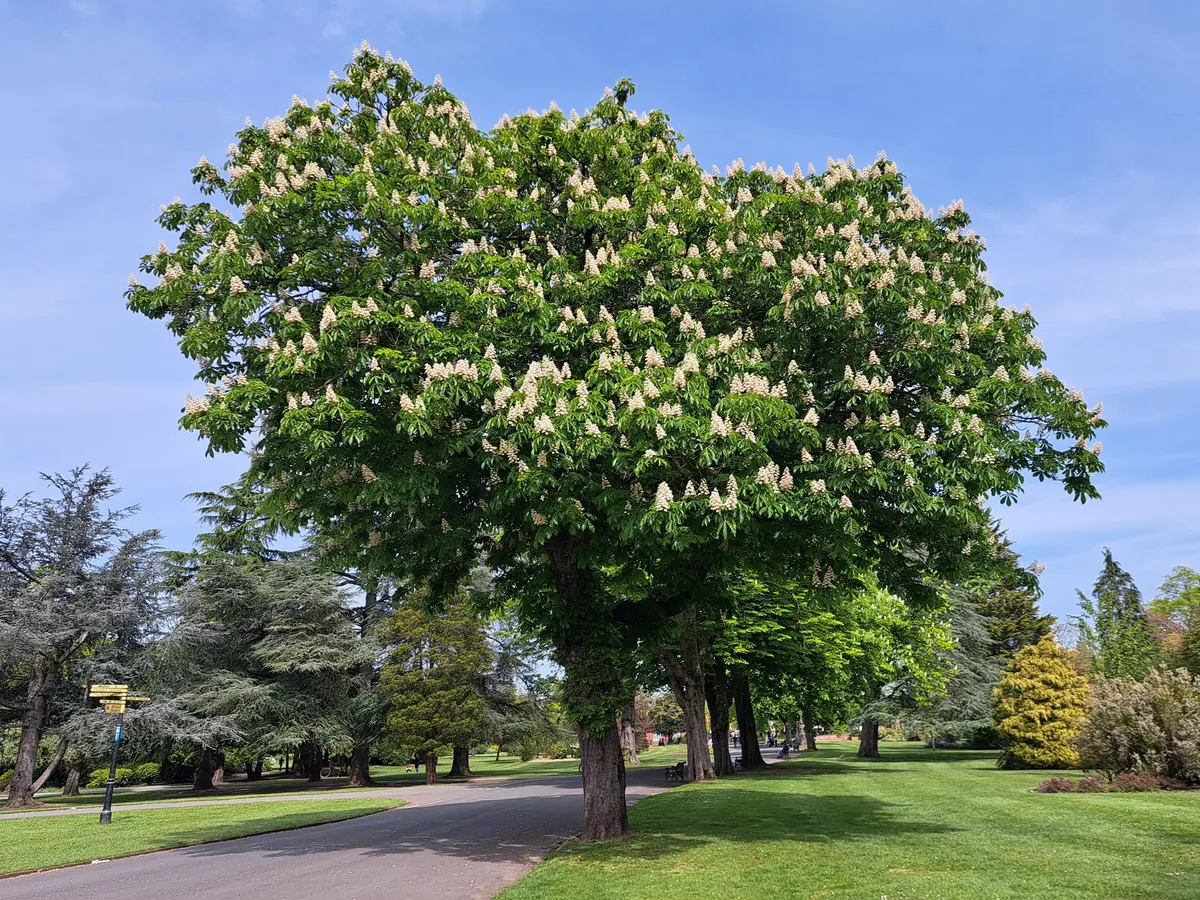
Horse chestnuts are easy to identify once you know the shape of them: big palmate leaves with five to seven leaflets, a broad domed crown, and bark that turns grey and scaly with age. In spring the flowers stand up in white or pink cones, which most people call candles. By late September those candles have become spiky green husks.
Timing shifts with latitude and weather. In southern England the first proper drop often lands in the last week of September. In Scotland, or in a cold year anywhere, it can be mid-October before husks start splitting. Wind and rain do most of the work of bringing them down.
Signs you have found a good tree
- Split husks scattered under the canopy, especially on tarmac and paths where they are easy to spot
- Conkers collecting along kerbs, wall bases, drains and the bottom of slopes, where they roll and settle
- Nuts with a glossy shell and a pale circular scar, the mark where the conker sat inside the husk
- Last year's shrivelled husks still caught in the branches, a fair indication of a heavy cropper
- Clean shells — a neat round hole means something has already been inside and left
London and the South East
The capital has far more horse chestnuts than most people realise, largely because Victorian park designers liked them for avenues and boundary planting. Hyde Park and Kensington Gardens, the northern edges of Hampstead Heath, Greenwich Park, Blackheath, Wandsworth Common and the older, quieter corners of Richmond Park are all worth a look. Older suburban avenues in places like Ealing, Waltham Forest and Bromley are often lined with them too, and residents rarely bother to collect.
Further out, try the town commons of Surrey and Kent, Brighton's Preston Park, Southampton Common and the riverside parks around Reading and Oxford. Anywhere with a Victorian or Edwardian park layout is a reasonable bet: the planting fashion of the period was generous with chestnuts.
The Midlands and the East
Birmingham does well out of Cannon Hill Park and the vast sprawl of Sutton Park. Leicester's Abbey Park, Nottingham's Wollaton Park and Northampton's Abington Park all hold mature trees, and Cambridge's Parker's Piece and Jesus Green are easy pickings on a lunch break. East Anglia is flatter and windier, so the best trees tend to sit in sheltered spots: town parks, cemetery edges, school boundaries and the banks of the old canals.
Northern England
In Manchester, Heaton Park and Fletcher Moss are the obvious starting points, with Platt Fields close behind. Sheffield has Endcliffe Park and the tree-lined edges of Ecclesall Woods, though the woods themselves are less productive than open ground. Leeds offers Roundhay Park and Woodhouse Moor; Newcastle has Jesmond Dene, Exhibition Park and Leazes Park; Liverpool has Sefton Park and the Calderstones estate. Converted railway lines and canal towpaths across the industrial north are quietly excellent — long, sheltered and rarely picked over.
Scotland
Glasgow's Kelvingrove Park, Queen's Park and the grounds of Pollok Country Park are all reliable in a decent year. In Edinburgh, the Meadows, Inverleith Park and Saughton Park are the usual haunts. Dundee's Baxter Park and Aberdeen's Duthie Park do the job further north, alongside the country parks and estate policies around larger houses, where avenues of chestnuts were planted for show.
Access north of the border is generous, but the right to roam is about crossing land on foot. It does not amount to a right to take things away. If a spot feels ambiguous, ask.
Wales and the South West
Cardiff's Bute Park and Roath Park are the pick of south Wales, with Swansea's Singleton Park and Newport's Belle Vue Park close behind. Around Bristol, the Clifton Downs, Brandon Hill and Ashton Court are all productive, and Bath's Royal Victoria Park rarely disappoints. Further west, horse chestnuts dislike exposed, salt-laden coastal wind, so the best trees are usually inland — sheltered town parks, churchyards and river valleys in Devon, Somerset and Cornwall rather than the cliff edges.
A practical routine, and how to forage without being a nuisance
Once you know a few trees, the routine is simple and quick.
- Go the morning after a windy night. You will beat the school groups and the dog walkers, and the husks will still be lying where they fell.
- Work the perimeter of the canopy first, not the trunk. Most conkers land well outside the drip line.
- Check downhill. Conkers roll, and they gather against kerbs, walls, gateposts and drains.
- Reach hanging husks with a long stick if they are genuinely low. Never climb, and never shake or break a branch.
- Sort at home and dry your haul in an open tray in a cool, airy room. Baking and vinegar soaks are old folklore; a fortnight on a shelf does the job better and leaves the shells hard.
Take what you will actually use and leave the rest. Fallen conkers feed squirrels, deer and other wildlife through the autumn, and a park that gets stripped clean in a weekend is a park that gets less welcoming the following year. Rules vary: many public parks tolerate a pocketful for personal use, while nature reserves, private estates and some council-managed sites ask you not to remove anything at all. If there is a sign, follow it. If there is a ranger, ask.
One safety point that matters more than any conker technique: horse chestnuts are not edible. They are not sweet chestnuts, they are bitter and harmful if eaten, and they should be kept away from young children and pets. If you think someone has swallowed one, contact a doctor or NHS 111, and a vet for animals, rather than waiting to see what happens.
Then get home, sort the best few into a bag, and find someone to play against. The tree you find this October will almost certainly be there next year, and the year after that, quietly dropping its load onto the same few metres of pavement.
Photo: Robin Osolinski / Pexels